How long do veneers last and how to care for them
Patients who decide on veneers almost always ask the same question: "How long will they last?" The honest answer is far more optimistic than most people expect.
Statistically, ceramic veneers maintain their aesthetics for 10–20 years. That's a wide range — and the difference between 10 and 20 years comes down not to luck, but to specific factors the patient controls themselves.
How Long Veneers Really Last
Clinical research shows a 10-year survival rate for ceramic veneers of around 93–94%. That means out of 100 veneers, only 6–7 will need replacement or significant correction after a decade. In medicine, that's an exceptionally strong result.
Factors that affect lifespan:
Material:
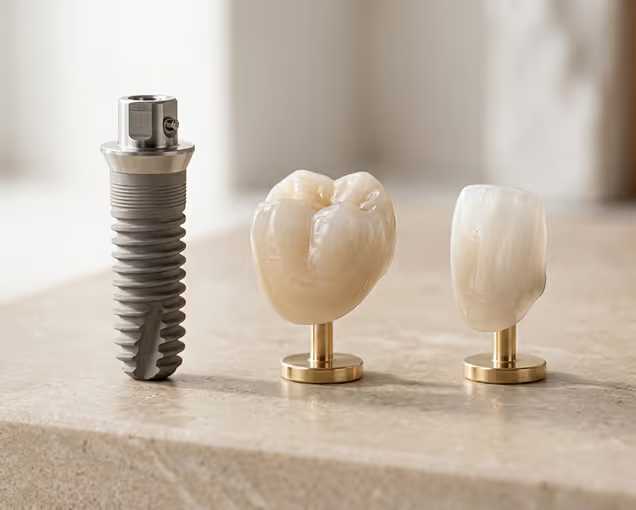
- E-max ceramic (lithium disilicate) — the most widely used and well-researched material, lasts 12–20 years
- Feldspathic ceramic — more fragile but extraordinarily aesthetic, 8–15 years
- Zirconia — the most durable, suitable for posterior teeth, 15–25 years
Bonding technique: the quality of the adhesive protocol — how the veneer is bonded to the tooth — is one of the key factors. Poor bonding shortens the lifespan regardless of material quality.
Patient's dental health: bruxism, acid erosion, gum disease — all of these have an impact.
Care: covered in detail below.
What Most Often Destroys Veneers Prematurely
Bruxism — The Main Threat
Night-time teeth grinding (bruxism) generates forces far exceeding normal chewing load. Ceramic handles eating — but not systematic grinding. If you have bruxism, an occlusal splint is non-negotiable. It's a guard worn at night that absorbs the load instead of the veneers.
At ALLURE DENTAL:
- Protective silicone splint (Combi-plast) — 1,800 UAH
Hard Objects
Veneers are ceramic. They are strong under the forces of eating, but not designed for:
- Biting nails, pens, or pencils
- Cracking nuts or stones with the front teeth
- Opening bottles or packaging with your teeth (this should stop regardless)
Acid Erosion
Ceramic is resistant to acid, but the bonding cement is less so. Regular consumption of carbonated drinks, citrus juices, and acidic foods gradually affects the veneer-to-tooth margin.
Neglecting Professional Hygiene
A veneer can't get a cavity — but the tooth beneath it can. If plaque accumulates between the veneers and gums and inflammation develops, the veneer will need to be removed for treatment.
Veneer Care Guidelines
Daily Hygiene
Brushing: twice a day with a soft or medium-bristle brush. A hard brush can scratch the veneer surface and damage the glazed layer.
Dental floss or interdental brushes: essential for the spaces between teeth. The veneer covers only the facial (front) surface — it doesn't extend between the teeth.
Water flosser: useful for cleaning the gum sulcus, but not a replacement for floss.
Toothpaste: avoid highly abrasive products (RDA above 70). Whitening pastes containing charcoal particles or coarse abrasives are off-limits.
What to Eat and What to Avoid
Everything is fine — veneers require no dietary restrictions for normal eating. But there are nuances:
- Coffee, tea, red wine: ceramic doesn't absorb them, but the cement at the veneer margins can darken slightly over time. Rinsing with water afterwards is a good habit.
- Hard foods: fine to chew, but not with the front teeth. Nuts, crackers, hard caramel — use the back teeth.
- Ice: chewing ice is one of the most common causes of chipping — on any teeth, not just veneers.
Regular Dental Visits
Every 6 months — professional cleaning and a check-up. The doctor examines the condition of the gums, the integrity of the veneers, and the bonding cement. If a minor issue is found, it's resolved immediately, before it becomes a bigger problem.
What to Do If a Veneer Chips or Comes Off
Don't panic — this is manageable. What to do:
- Keep the chipped fragment or veneer — bring it to the appointment
- Call the clinic as soon as possible
- Until the appointment, avoid chewing on that side
- If the exposed tooth is sensitive, it can be temporarily covered with dental wax from a pharmacy
What the doctor can do:
- Re-bond — if the veneer came off intact and in good condition
- Polish or repair — for a minor chip
- Fabricate a new veneer — if the damage is significant
Can Veneers Be Whitened If They Have Darkened
Short answer: no. Ceramic does not respond to whitening agents — neither home nor clinical. If veneers appear darker, the causes may vary:
- Darkening of the cement at the margins — can be polished by the doctor
- Darkening of the tooth beneath the veneer — if visible through the ceramic, the issue is in the tooth itself
- General surface dullness — polishing at the clinic restores the original shine
This is precisely why teeth are whitened before veneers are fitted — so the veneer shade is matched to the whitened tone.
When a Veneer Definitely Needs Replacing
- A visible chip or crack that cannot be polished out
- The veneer has detached and re-bonding is not possible (the shape has changed or the tooth has)
- Significant darkening that cannot be resolved by polishing
- A colour shift in adjacent teeth — the veneer no longer matches the overall tone
- A change in bite — for example, after orthodontic treatment
Frequently asked questions
Can I brush veneers with regular toothpaste?
Yes, but choose a paste without coarse abrasive particles or activated charcoal. A paste with an RDA rating up to 70 is safe for ceramic.
Can you feel the difference between veneers and natural teeth when chewing?
In the first few weeks, there may be a minor adjustment period. After that, chewing is indistinguishable from natural teeth. Most patients forget they have veneers within a month of fitting.
Do I need to remove veneers to clean them?
No. Veneers are a fixed restoration. Brush as normal, use floss, and a water flosser if needed.
Do veneers affect tooth sensitivity?
In the first 1–3 weeks after fitting, some increased sensitivity to hot and cold is possible — a normal response to enamel preparation. Persistent sensitivity after a month is a reason to see the doctor.
Is there a warranty on veneers?
At ALLURE DENTAL, a warranty is provided on both the doctor's work and the laboratory work — the terms are discussed individually depending on the complexity of the case. The warranty does not cover mechanical damage such as chips from biting bones or opening bottles.
Conclusion
Veneers are a long-term investment. 10–20 years without replacement through proper care is an entirely realistic scenario, supported by clinical evidence.
Three key conditions: an occlusal splint if you have bruxism, consistent daily hygiene, and check-ups every 6 months. Everything else is ordinary daily life with no special restrictions.